
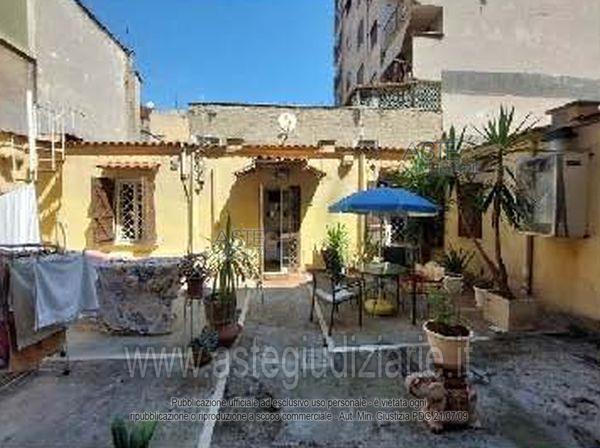
For investors searching for opportunities at the lower end of Rome’s property market, the judicial auction at Via Natale Palli 17 presents an unusual proposition. Situated in the established Torpignattara district of south-eastern Rome, the property combines an exceptionally low acquisition threshold with a location where ordinary residential asking prices are substantially higher. It is therefore an opportunity that may interest experienced investors comfortable with technical and legal due diligence and capable of evaluating assets that fall outside the conventional residential market.
The property is being sold through the Tribunal of Rome under Enforcement Proceeding R.G.E. 6/2025. The first auction is scheduled for 2 November 2026 at 14:00, with an official auction base price of only €30,000 and a minimum admissible offer of €22,500. The sale concerns 100% full ownership, rather than a fractional interest, and bidding will take place through an asynchronous electronic auction.
The asset is a ground-floor residential unit located inside the courtyard of the building at Via Natale Palli 17. Rather than forming part of the main multi-storey block, it occupies a separate single-storey structure within the internal courtyard, reached through the building entrance and a short internal passage. The auction notice records a conventional area of approximately 62 square metres.
Internally, the dwelling includes an entrance area, bedroom, an additional room without a window, living area with cooking facilities and a bathroom. Its independent position within the courtyard gives it a different character from a conventional apartment in a larger condominium building and may appeal to tenants or occupants who value ground-floor access and a degree of separation from the main residential block.
An Entry Price Far Below Ordinary Torpignattara Asking Levels
From an investor’s perspective, the headline price is immediately striking.
At the €30,000 auction base, the acquisition price corresponds to approximately €484 per square metre, using the 62 m² area stated in the auction notice. At the minimum admissible offer of €22,500, that figure falls to approximately €363 per square metre.
For comparison, current market data for Torpignattara in August 2026 reports average residential asking prices of approximately €3,106 per square metre, with asking values ranging from around €2,694 to €3,983 per square metre. The area’s average asking price has also increased compared with the previous year.
On a purely mathematical comparison, the minimum auction price is therefore approximately 88% below the current average residential asking-price level in Torpignattara.
That is an exceptional gap, but investors need to understand why it exists. This is not simply an ordinary apartment being offered at an 88% discount. The court-appointed expert was unable to identify a building title legitimising the courtyard structure, and the valuation was intentionally reduced to reflect the possibility that the building could ultimately have to be demolished.
That distinction is crucial. The low price creates potential upside, but it also reflects a substantial planning risk that must be independently investigated before bidding.
A Location with Stronger Values Than the Auction Price Suggests
The property’s surrounding location is one of the strongest elements of the investment case.
Torpignattara is an established and densely populated residential district with shops, local services and public transport. The court expert notes that Via Casilina is nearby, with the Torpignattara rail/tram transport corridor and several bus services accessible in the surrounding area.
Current asking-price data also shows that Torpignattara is not a €300–€500-per-square-metre market. Average residential asking prices are above €3,000/m², while asking rents reached approximately €20.10/m² per month in August 2026.
This distinction is important for investors: the exceptionally low auction value appears primarily related to the specific technical status of this property, rather than weakness in the surrounding residential market.
Evidence of Previous Rental Income
The documents also provide useful evidence of the property’s income-producing history.
A registered 3+2 residential lease commenced in June 2021 at a rent of approximately €600 per month, or €7,200 annually. The court-appointed expert actually incorporated this rental income into the valuation methodology.
This is valuable information for investors because it demonstrates that the property has previously functioned as an income-producing residential unit.
The lease was due to terminate at its second contractual expiry in June 2026, following notice to the tenant. Because that date has now passed, investors should obtain confirmation from the judicial custodian regarding the property’s current physical occupation before submitting an offer.
Why the €30,000 Court Valuation Is Unusual
The valuation methodology makes Property 4 very different from a standard auction apartment.
Because the expert could not establish the planning legitimacy of the structure, he did not simply multiply the apartment’s area by normal neighborhood property prices. Instead, the valuation considered the possibility of approximately ten years of rental income followed by eventual demolition.
Demolition and associated professional and administrative expenses were estimated at approximately €11,500. After discounting future income, demolition expenses and judicial-sale risks, the expert arrived at approximately €30,000.
For sophisticated investors, this creates two very different possible scenarios.
Under the conservative scenario used by the court expert, the investment is principally connected to temporary use and rental income before a potential future demolition obligation. A very different investment case could emerge if specialist legal and technical investigation establishes a defensible route to preserving or regularising the structure.
That second outcome should not be assumed, but it explains why professional planning due diligence could be particularly valuable here.
Potential Benefits for the Right Investor
The property’s attractions are therefore concentrated around low capital exposure, full ownership, an established Rome location and historic rental income.
A minimum bid of €22,500 is small compared with most residential acquisitions in Rome and may make the property accessible without the financing requirements associated with larger auction purchases. The surrounding district has active residential sale and rental markets, and the property has already demonstrated an ability to generate monthly rent.
At the same time, this is an opportunity for an investor prepared to investigate complexity rather than simply purchase a conventional apartment.
The court documents disclose important issues, including the absence of an identified building title, possible demolition exposure, cadastral matters, maintenance issues and condominium liabilities that require verification. These risks are precisely why the auction price is so unusual.
For that reason, Via Natale Palli 17 should be viewed as a specialised, higher-risk investment rather than an ordinary discounted apartment. For an investor who commissions proper Italian planning, legal and condominium due diligence—and establishes exactly what can lawfully be done with the property—the exceptionally low entry price relative to ordinary Torpignattara values could make this one of the more distinctive judicial-auction opportunities currently available in this part of Rome. If you want initial due diligence of this property, contact us.